

Bitcoin Network Hashrate: From the Early Days to Today (and What Comes Next)
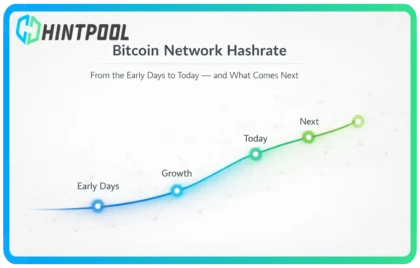
Bitcoin’s network hashrate is one of the most important “health” and security indicators in Proof-of-Work.
It represents the estimated total amount of SHA-256 computation currently securing the Bitcoin blockchain.
Over time, hashrate has grown by multiple orders of magnitude—driven by hardware innovation (CPU → GPU → FPGA → ASIC),
miner economics, and global energy/hosting infrastructure.
1) What “Hashrate” Really Measures (and Why It’s an Estimate)
Bitcoin does not measure hashrate directly. Instead, it is estimated from observed block production and the current
mining difficulty (because difficulty is calibrated so the network targets ~10 minutes per block). As a result,
daily readings can be noisy; many analysts prefer smoothed series (e.g., 7-day averages) to reflect underlying trends.
Practically, when hashrate rises, the network becomes more resistant to attacks because an adversary must acquire
(or control) a larger share of total compute to compete with honest miners.
2) Hashrate Growth Timeline: The Major Eras
2009–2010: CPU Mining (Kilohash to Megahash Scale)
In Bitcoin’s earliest period, mining was performed on consumer CPUs. Total network hashrate was tiny compared to modern levels,
and single participants could meaningfully influence block discovery.
2011–2012: GPU Mining (Megahash to Gigahash Scale)
As the ecosystem grew, miners shifted to GPUs, which are far more efficient at parallelized hashing. This transition
pushed network hashrate into new magnitudes and made solo CPU mining largely uncompetitive.
2013–2015: The First ASIC Wave (Terahash to Petahash Scale)
ASICs (application-specific integrated circuits) fundamentally changed Bitcoin mining. Dedicated SHA-256 hardware delivered
step-function efficiency gains, rapidly expanding total network compute while forcing continuous hardware refresh cycles.
2016–2020: Industrialization (Petahash to Exahash Scale)
Large-scale mining operations, professional hosting, and capital-market participation became defining features.
Hashrate growth increasingly reflected industrial deployment schedules, power procurement, and supply chains.
2021–2025: The Zettahash Era Begins (Exahash to Zettahash Scale)
By 2025, the Bitcoin network crossed the 1 ZH/s threshold (1,000 EH/s), marking another milestone in cumulative security power.
Hashrate has remained highly dynamic, oscillating with miner profitability (“hashprice”), energy costs, and new ASIC deliveries.
For a live, long-range history chart of Bitcoin hashrate (all-time), you can reference:
Blockchain.com – Total Hash Rate
and
BitInfoCharts – Bitcoin Hashrate.
3) Where Hashrate Stands Now (Late 2025 Snapshot)
Multiple data providers place Bitcoin’s current network hashrate around the ~1.1 ZH/s range in late 2025,
with an observed all-time high around ~1.44 ZH/s earlier in 2025 (depending on methodology and averaging windows).
Variations across dashboards are normal because hashrate is inferred, and providers use different smoothing and sampling.
4) What Actually Drives Hashrate Up (or Down)
- Bitcoin price vs. hashprice: When BTC price rises faster than network difficulty, mining margins expand and more capacity comes online.
- ASIC efficiency leaps: New generations (lower J/TH) can profitably replace older fleets, lifting total hashrate even if total power usage stays flat.
- Energy availability and pricing: Sub-3¢/kWh power and strong demand-response/grid deals can materially change fleet economics.
- Deployment constraints: Manufacturing lead times, logistics, customs, and hosting buildouts create “step” growth rather than smooth curves.
- Regulatory and geopolitical shocks: Policy changes can relocate hashrate and temporarily reduce capacity until redeployed.
5) Forecasting Hashrate: A Practical, Source-Based View (Not Hype)
Hashrate forecasting is inherently uncertain because it depends on future BTC price, miner financing conditions,
ASIC delivery timelines, and energy costs. The most credible forecasts tend to publish assumptions explicitly
and treat projections as models—not promises.
CoinShares (Model-Based Projection)
CoinShares’ Q4 2025 mining report notes that Bitcoin surpassed 1 ZH/s in late August 2025 and places the network
around ~1.1 ZH/s at the time of writing. Their updated model projects roughly ~1.2 ZH/s by year-end 2025
and ~2.0 ZH/s by February 2027.
Scenario Thinking: What Would Make 2026–2027 Faster or Slower?
- Faster-than-modeled growth: sustained BTC price strength, rapid ASIC efficiency improvements, abundant hosting/power capacity, cheap financing.
- Slower-than-modeled growth: compressed hashprice, higher energy prices, delayed ASIC deliveries, tighter capital markets, or policy friction in key regions.
The key takeaway is that the network’s long-run trajectory has been up and to the right,
but the rate of increase can vary sharply across months and quarters.
6) Why This Matters to Miners and Pools (Including Hintpool Users)
For miners, rising network hashrate generally means higher difficulty over time, which reduces the share of blocks
you earn per unit of hashpower unless you also scale or upgrade efficiency.
That is why payout method transparency (e.g., FPPS/PPS variants), fee structure, uptime, and fast payouts matter:
in a competitive environment, operational details can be the difference between stable cashflow and missed revenue.
Hintpool helps miners stay competitive with reliable pool infrastructure, clear payout terms, and consistent performance.
If you want a tailored profitability view (hashrate, efficiency, power price, and payout method), publish a calculator
alongside this article—readers love it, and it converts.