

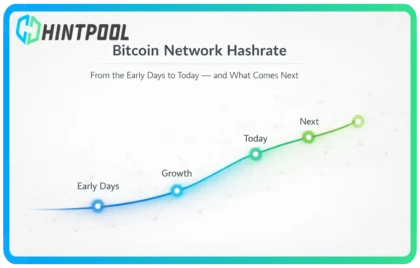
Bitcoin’s network hashrate is one of the most important “health” and security indicators in Proof-of-Work. It represents the estimated total amount of SHA-256 computation currently securing the Bitcoin blockchain. Over time, hashrate has grown by multiple orders of magnitude—driven by hardware innovation (CPU → GPU → FPGA → ASIC), miner economics, and global energy/hosting infrastructure. […]

In blockchain networks, a consensus mechanism is the rule set that allows thousands of independent nodes to agree on a single, valid transaction history without a central authority. Two dominant models are Proof of Work (PoW) and Proof of Stake (PoS). This article explains how each works, what they optimize for, and what the trade-offs […]
Mining pools use payout schemes to decide how your submitted shares translate into BTC and who absorbs variance risk (luck, orphan risk, fee volatility). The differences between PPS, FPPS, and PPS+ look small on paper, but they materially affect day-to-day revenue stability. 1) PPS (Pay Per Share) What you get paid for You are paid […]
Bitcoin is ending 2025 in a familiar posture: volatile enough to command attention, but structurally robust enough to keep operating through macro noise, shifting liquidity, and relentless mining competition. Below is a data-led snapshot of where Bitcoin stands today—and what it implies for miners and mining pool participants. 1) Market Snapshot (as of Dec 27, […]